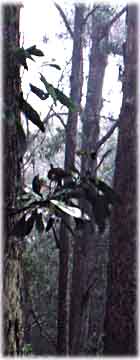




The South Coast Forests cover the NSW South Coast from north of Nowra to south of Narooma, and inland almost to Queanbeyan and Canberra.
Most of the natural, terrestrial habitats in the South Coast are part of wider ecosystems dominated by forests. These forest-dominated ecosystems cover 793,102 ha of public land in the South Coast region. Of this area, 372,796 ha are State Forest, 338,083 ha are National Park and 82,223 ha are vacant Crown Land.
Within the forest, coastal, heath and non-marine aquatic environments that make up the forest-dominated vegetation communities of the South Coast, are over 400 species of native mammals, birds, reptiles and amphibians. These represent 20%, or one-fifth, of Australia's total native mammal, bird, reptile and amphibian species. Included are 270 birds (36% of Australia's birds), 72 mammals (27% of Australia's mammals), 40 reptiles (5% of Australia's reptiles) and 22 frogs (11% of Australia's frogs). There may be many species occurring in the South Coast which have not yet been discovered and could be added to this list.
Sixty of these species are listed as threatened (endangered or vulnerable) by the NSW Threatened Species Conservation Act. This is 15% of the total known native species in the South Coast. The list includes endangered species like the Eastern Bristlebird, Broad-headed Snake, Southern Brown Bandicoot, Green and Golden Bell Frog, Smoky Mouse, Hooded Plover and Regent Honeyeater. Many of these species are forest-dependant or forest users.
The CSIRO noted that "reductions in the populations of a number of species have occurred since first settlement, notably those of the Koala, several species of small macropods, and the native quolls."
- Cocks, K.D., Ive, J.R. and Clark, J.L. (editors). 1995. Forest Issues: Processes and tools for inventory, evaluation, mediation and allocation. CSIRO, Canberra. P.11
The South Coast forests also contain a wide diversity of old-growth forest types, from tall wet forest to dry open forest. The tall wet old-growth forests are majestic, with trees over 50 metres high (equivalent to a 12 story building) and 10 metres in girth. Old-growth forests have been identified under the NSW Government's Interim Assessment Process to be likely to cover almost 60,000 hectares on State Forest estate, or over 16% by area of State Forests in the South Coast region.
Forests which are biologically productive, with nutrient-rich soils or on flatter terrain, are even rarer. A CSIRO report states: "Of the fauna still extant [in the Batemans Bay forests], a strong association exists between the abundance of fauna and forest fertility"
- Cocks, K.D., Ive, J.R. and Clark, J.L. (editors). 1995. Forest Issues: Processes and tools for inventory, evaluation, mediation and allocation. CSIRO, Canberra. P.11
In another study of a large part of the South Coast forests, the CSIRO found that: "Tree associations that characterised the most productive sites and, on average, the most accessible land were. least represented in National Park and. most extensively disturbed by logging or clearing."
- Braithwaite, W., Belbin, L., Ive, J., and Austin, M., CSIRO. 1993. Land use allocation and biological conservation in the Batemans Bay forests of New South Wales. Pages 4-21 in Australian Forestry Vol. 56 (1).
The South Coast contains a diversity of rainforests which are widespread throughout the region, including rare littoral rainforest on the coast, cool-temperate rainforest, warm-temperate rainforest and sub-tropical rainforest. Included are many rainforest species at the northerly or southerly extent of their ranges. Some cool temperate rainforest contains trees potentially five thousand year old (Pinkwood trees, Eucryphia moorei; pers. comm. Alex Floyd, 5 July 1999).
The South Coast contains a number of magnificent wilderness areas loved by bushwalkers across the State. A number of these are currently not protected; the Brogo/Tuross extensions in Wandella State Forest, Tuross in Badja State Forest, Deua in Dampier State Forest, Buckenbowra in Monga and Buckenbowra State Forests, and Ettrema in vacant crown land near Nowra.
The South Coast region has enormous tourism potential. The northern South Coast - Shoalhaven Shire - is the number one tourism destination in the State for commercial accomodation, and second only to Sydney for all visitation; tourism is worth $348 million annually to the Shoalhaven region. In the southern South Coast - Eurobodalla Shire - ('Eurobodalla Nature Coast.'), 794,000 visitors to the Eurobodalla Shire in 1995-96 brought in $183 million. The South Coast region relies on its natural features - beaches, mountains and forests - to attract tourists and recreationists.
It may be noted that an economic study ten years ago found that the total value of forestry production for the Batemans Bay Region (including Nowra, Moss Vale and Queanbeyan Districts) was only $4.7 million. In the Eurobodalla Shire at that time, tourists spent $111 million. Dairy and bees both are affected by logging (dairy through loss of water as old-growth is replaced by regrowth, and bee farming through loss of diversity and seasonality of flowering plants through loss of old-growth and other factors) - agricultural commodities were worth $10.1 million at that time in Eurobodalla. Oyster farming alone (which is affected by logging through siltation) was worth $2.4 million.
Price Waterhouse Urwick. 1989. Eurobodalla Shire economic development strategy, Stage 1: Regional economic profile.
Forestry, agriculture and fishing together employed only 6.3% of the Eurobodalla's workforce in 1991, while tourism employed 13.4%.
Both shires are critically reliant on an unspoiled natural environment for tourism. The following contrasts the value of the timber industry and the tourism industry to the regional economy.
Eurobodalla Shire - 1996/8 ( from Eurobodalla Shire Council Plan Of Management 1998, Moore D 1997 and Centre For Agricultural and Research Economics 1996)
tourism expenditure $183 million
tourism related employment 1998 2656 people
est. value of timber products logged $1.5 million or less
sawmill employment 92 people
Shoalhaven Shire - 1996/7 (from Shoalhaven Council Profile and Statement of Economic Impact 1996/7 pub. Feb 1998)
tourism expenditure $348 million
tourism related employment 3900 people
value of timber products logged $1.5 million
all forestry employment 32 people
With tourism in Eurobodalla and Shoalhaven Shires being worth over $500 million annually, forestry - bringing in around $5 million (1% of tourism income) from a larger area - is clearly an industry which should not be promoted at the expense of tourism.
The South East Forest Alliance has identified 15 of the most important largely forested areas which are still unprotected in the South Coast Forests. These 15 areas are the 'Community Reserve Proposals' (CRPs) of the South East Forest Alliance for the South Coast forests.
These CRPs are the community icon areas of the South Coast forests - the 'flag ships' of the forest protection campaign. They are all areas with tremendous environmental values and community concern, and have been identified as essential for an adequate and viable reserve system design for the region.
SEFA is proposing these areas be protected as national park, to form the basis of a Comprehensive, Adequate and Representative forest reserve system under the NSW Comprehensive Regional Assessment (CRA) process.
SEFA is further proposing that the many areas which will be identified beyond these CRPs, for example through the CRAs, will also need to be reserved. SEFA expects that this will include all old-growth forest, all wilderness, all rainforest, habitat of threatened species, habitat that provides refugia or source populations for flora or fauna, fauna corridors, and other areas of crucial conservation significance.
It should especially be noted that SEFA is proposing the Clyde River catchment (roughly above the town of Nelligen on the Kings Highway) to be a Major Catchment Protection Area (MCPA), where logging and roading operations would need to be severely modified for catchment protection. This MCPA would cover 57,000 ha of public land (state forest). The Clyde River is the only unregulated major river remaining on the NSW coast, and as such is of enormous environmental and scientific significance.
Such a reserve system would provide a continuous link from the southern to the northern border of the South Coast region (north of Nowra to South of Narooma). Added to the South East Forests National Park to the south, this would provide a continuous protected area along the escarpment of over 300 kilometres, the longest connected stretch of protected areas in the State. Further, the proposed reserve system would provide at least four escarpment to coast corridors in national park (presently there are none), a situation which is essential for long-term conservation in the face of climate change, habitat reduction, and ongoing evolutionary processes.
In total, the 15 CRPs contain 205,102 ha, comprised of 180,478 ha of State Forest , 22,797 ha of vacant Crown Land. and 1827 ha of Flora Reserve.
SEFA is also advocating protection of forests beyond the Community Reserve Proposals. It is proposing that the South Coast be a woodchip free zone; that no old-growth forests, wilderness areas or rainforests be logged; and that important water catchments and threatened species habitat be protected.