Describing patterns
in nature
Leigh Wood
Director of the Mathematics
Study Centre
University of Technology, Sydney.
|
Fractals Describing patterns |
|
When people visit national parks, some see the birds, some the Aboriginal carvings, some see trees and some see rocks. Many people see the geological formations, the hydrology of the systems, the interactions between flora, fauna and people. Me, I see mathematics. |
 Chaos
and fractals
Chaos
and fractals
Chaos is a branch of mathematics that deals with non-linear dynamic systems (that is, that do not proceed in a direct fashion and are ever changing). It so happens that many natural systems fit this category. Chaos is used in the study of turbulence, like eddies in a stream; it can be also used to describe snowflakes, clouds and many natural phenomena. Chaotic systems can easily be mistaken as being completely random despite the fact that they always follow a particular set of rules. This is partly because they can look messy or unstructured (but really have underlying structure) and partly because chaotic systems can be predicted only on very short-term time scales. One part of chaos theory deals with fractals and fractal geometry.
| A fractal is a space with a fractional number of dimensions. Think about dimensions. One dimension (length) is like a straight line, such as the train line across the Nullarbor; two dimensions (area) is like a flat piece of paper; and three dimensions (volume) is like a room, with walls and a ceiling. We are all used to living in three-dimensional space and being able to easily categorise objects into one, two or three dimensions. However, sometimes this kind of categorisation is not so obvious, or perhaps not so useful. For example, when we study the lungs, we consider all the small sacs that make up the lungs. It is clear that the surface area is huge (because of its complexity) which allows us to breathe efficiently, but the lungs are contained in a small volume. In a mathematical system, we can consider the lungs to have a fractional dimension somewhere between 2 and 3. | 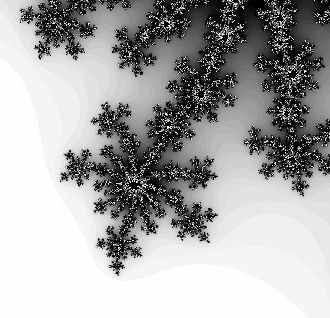 |
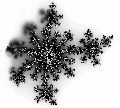
Another example is an individual snowflake. If you tried to trace around the outside of a snowflake to find out how long it is (provided it did not melt first), you would find the length difficult to measure but it would certainly be very long. The flake itself has a small area. So we can think of the snowflake as having a dimension somewhere between 1 and 2.
Fractals have another interesting property. They have a self-similar structure on every scale – the shape remains the same however closely you look at it. No real structure can be magnified repeatedly an infinite number of times and still look the same. The principle of self-similarity is nevertheless shown approximately in nature: in coastlines and riverbeds, in cloud formations and trees, in the turbulent flow of fluids.
Look at the graphic of the snowflake above. If we took a magnifying glass and looked at part of the boundary (see close-up opposite), it would look as crumpled as the large version. This is what we call the fractal structure of the boundary. It reminds us of coastlines, of many natural boundaries which apparently become longer the finer the scale on which we measure them. One of the peculiar things about the boundary is the self-similarity. If we look at any corner or bay, we notice that the same shape is found at another place in another size. This is very common in nature – fern leaves look similar in different scales, clouds, snowflakes, coastlines: all are self-similar.
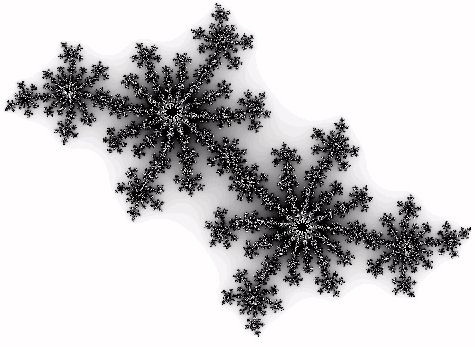 |
Images
created by Tim Keighley, using "Fractal Forge" © Uberto Barbini |
Nature abounds in areas that can be described using fractals. Geology is one area: "… geological systems may be successfully modelled … and analysed using the concepts of fractal geometry." (Alison Ord, In: Fractals and Dynamic Systems in Geoscience. J.H. Kruhl (ed). Springer-Verlag. 1994) The geometry of soils ("Down on the fractal farm", New Scientist, 23.8.97) and repeating rock patterns ("Fractal rock", New Scientist, 12.7.97) are also described using fractals.
Here is an example of fractals that may surprise you. Heartbeats show fractal patterns: "... if the heart speeds up over a short sequence of beats, it will slow down again over the next few beats. More importantly, the pattern of these speed-up/slow-down events can be seen on both short and long time scales: it looks the same over a few beats as it does for a thousand beats. In other words, the heartbeat has a fractal pattern." ("A different beat", New Scientist, 4.12.99) Did you know that mammals’ hearts beat approximately 1.5 billion times in their lifetime? It does not matter if it is a whale or a bilby or a mouse. In smaller animals the heart beats faster and they die sooner; with large animals the heart beats slower and they live longer. When mathematicians see these kinds of patterns they get very excited. If there is a pattern, there may be a reason for that pattern and we get closer to understanding nature.
Looking
for connections
The environment movement and those associated with the love of nature come from many backgrounds. We need people on the ground protecting the natural environment, we need people observing and collecting data. We need communicators and educators to carry the message of the importance of the natural environment to those who are not so aware. We also need the theorists, those who look for patterns, look for connections between natural phenomena (and indeed between nature and humans) and formulate these into theories for testing.
The ideas behind fractals are simple and powerful. They are a useful way to describe scale-invariant processes in nature. Mathematically, the equations that generate fractals are simple, but allow complex patterns to be generated easily (such as the fractal of the fern on the front cover). This conciseness of coding is perhaps how nature designs itself.
Leigh Wood
Director of the Mathematics Study Centre
University of Technology, Sydney.
|
|
National
Parks Association - Home Page |
|